
Many engineers and buyers struggle with the same questions: Which bracket geometry fits this load? What material balances strength, weight, and cost? How thick should it be, and where should the holes go? This guide walks through bracket types, materials, design rules, and manufacturing so you can specify the right bracket the first time.
Key Takeaways
- Bracket geometry (L, U, Z, or gusset) must match load direction and mounting, not free space
- Minimum bend radius is typically 1-2x material thickness, based on ductility
- Stainless for corrosion; aluminum for weight; carbon steel for cost and strength-per-dollar
- Finish (powder coat, zinc, anodizing) affects maintenance and commercial fire-code compliance
- Apply a 1.5-2x safety factor to expected load when sizing any bracket
What Is a Sheet Metal Bracket?
A sheet metal bracket is a support formed from flat metal stock—typically steel or aluminum—then bent into shapes like L, Z, or U. It sits between two parts and connects them with fasteners, welds, or rivets, transferring load from one member into the other.
In retail and industrial settings, that usually means shelf supports, equipment mounts, and panel connectors.
What's the Difference Between a Brace and a Bracket?
A brace primarily resists movement or adds rigidity along an axis. A bracket connects and supports two separate components, often at an angle.
Think of a diagonal brace inside a steel frame: it stops the frame from racking under lateral load, but it doesn't hold anything up.
An L-bracket mounting a shelf to a wall does the opposite job. It isn't stiffening a whole structure; it's transferring the shelf's weight into the wall. Same category of hardware, completely different role.
Types of Sheet Metal Brackets
Bracket geometry isn't arbitrary. You choose it based on load direction, mounting configuration, and how much space you have to work with.
L-Brackets (Angle Brackets)
The classic 90-degree single-bend profile. Common in:
- Shelving support (retail and residential)
- Corner reinforcement on enclosures
- General mounting hardware
They're simple to manufacture and cheap to tool, which is why they're everywhere.
U-Brackets (Channel Brackets)
Two bends form an enclosing channel shape. Use them to grip pipes, conduits, or components between parallel flanges, such as power supplies or hard drives inside an enclosure.
Z-Brackets
An offset double-bend profile that mounts panels sitting at different depths or heights. If you need to connect two parallel surfaces that aren't flush, a Z-bracket bridges the gap without extra spacers.
Gusset Brackets
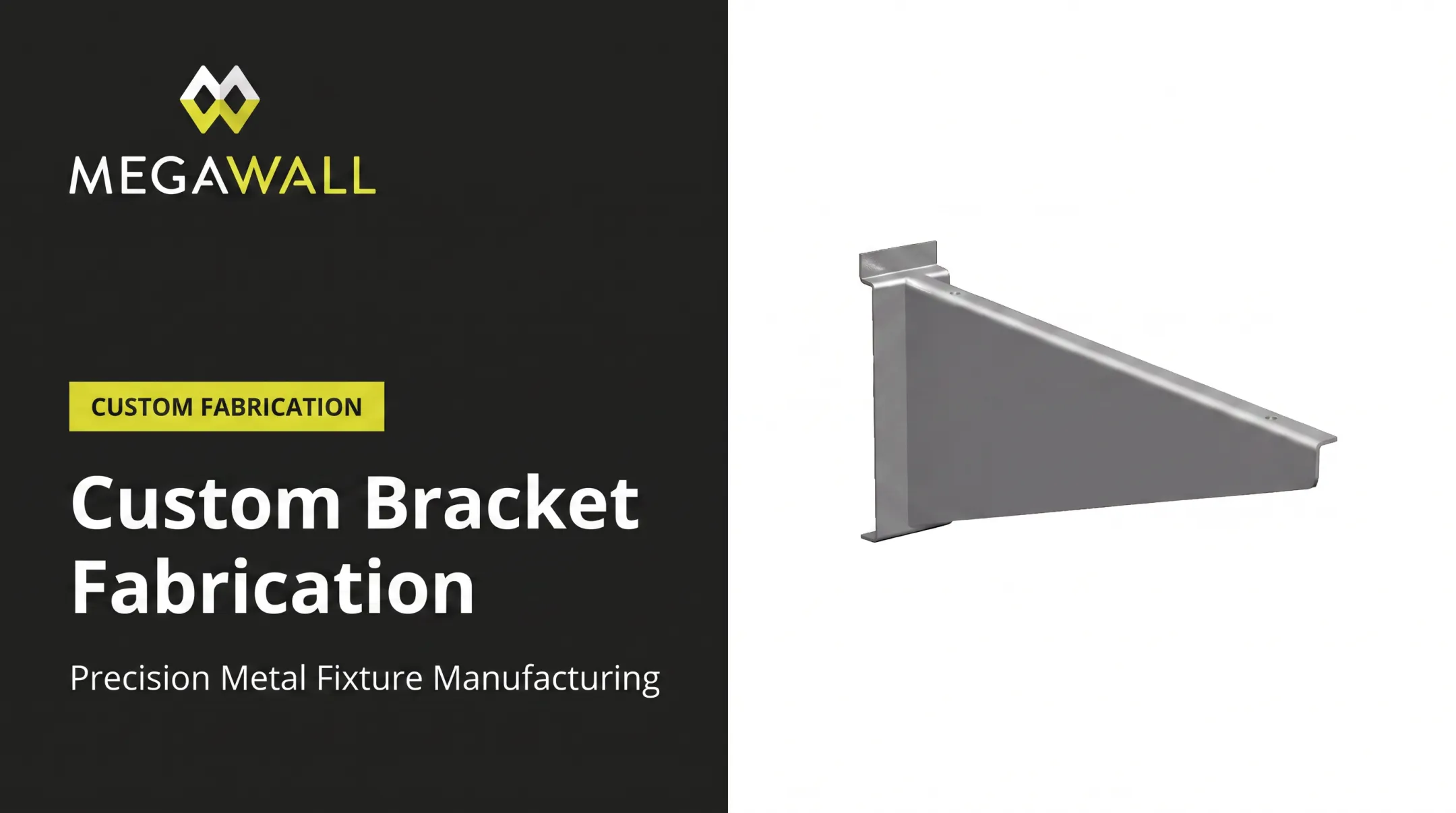
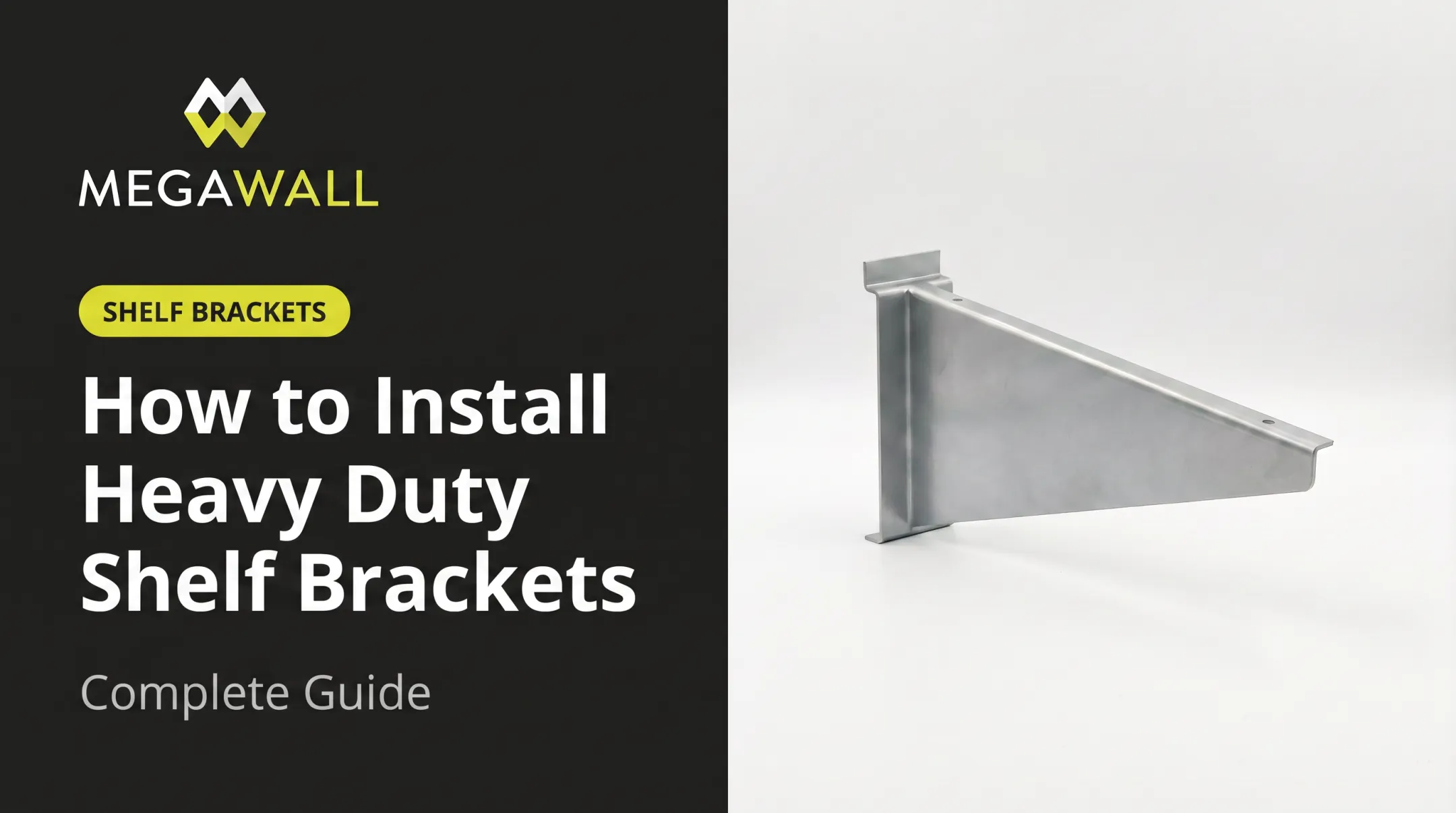
A triangular reinforcing section that increases resistance to bending and torsion. Gussets can be welded onto an existing joint or formed from a single piece of material. Manufacturers typically weld gussets in for maximum rigidity on load-critical joints.

Specialty and Adjustable Brackets
Custom, adjustable, and application-specific brackets show up in retail display, aerospace, and heavy equipment mounting. Megawall's own heavy-duty shelf brackets fall into this category. They're formed and welded from heavy-gauge steel, available in standard 12", 14", 16", and 18" lengths, with custom sizes for oversized or unusually shaped merchandise.
Choosing the Right Material for Your Bracket
Material choice depends on load capacity, corrosion exposure, weight limits, and finish requirements. Pick for the job, not for a generic "best" alloy.
Carbon/cold-rolled steel is the cost-effective workhorse for structural brackets. Per OnlineMetals' A1008 product guide, A1008 cold-rolled carbon sheet typically shows ultimate tensile strength around 49.9–51.9 ksi and yield strength of 26.1–34.8 ksi. You get a strong strength-to-cost ratio, but plan on a finish wherever corrosion is a factor.
Stainless steel holds up in outdoor, marine, and food-grade settings where corrosion resistance matters more than lowest cost. Type 304 carries a minimum tensile strength of 75 ksi and 0.2% yield of 30 ksi, so it often needs less protective finishing than carbon steel.
Aluminum cuts weight while resisting corrosion, which is why it shows up in automotive parts and retail fixtures. 6061-T6 aluminum sheet reaches roughly 42 ksi tensile and 35 ksi yield — competitive with lighter-duty steel at a fraction of the weight.
| Material | Tensile Strength | Yield Strength | Best Fit |
|---|---|---|---|
| A1008 cold-rolled steel | ~50 ksi | 26-35 ksi | Cost-sensitive structural brackets |
| 304 stainless steel | 75 ksi min | 30 ksi min | Outdoor, marine, food-grade |
| 6061-T6 aluminum | ~42 ksi | ~35 ksi | Lightweight, corrosion-resistant |
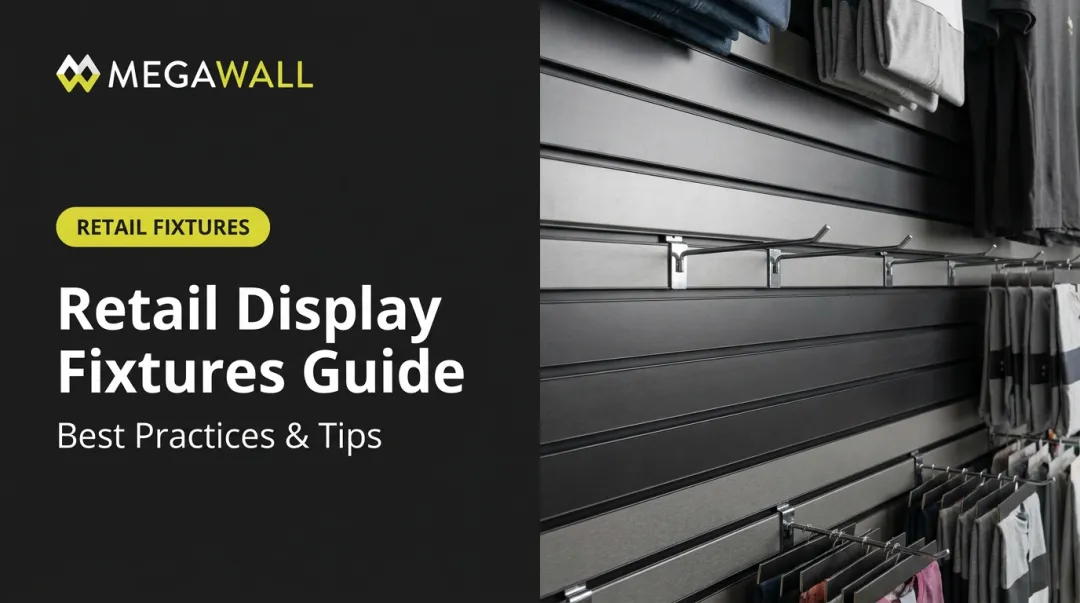
In retail fixture work, those tradeoffs show up fast. Megawall builds slatwall and display hardware from steel and recycled-content aluminum; the aluminum slatwall uses over 50% recycled material and still holds more than 50 pounds per linear foot. Material choice drives strength, weight, and sustainability at the same time.

Key Design Considerations for Sheet Metal Brackets
Bracket performance is decided early, in CAD, long before anything hits the shop floor. Thickness, bend radius, hole placement, and finish all interact.
Material Thickness and Bend Radius
Thicker material adds rigidity but resists forming. Thinner material bends easily but sacrifices stiffness.
Industry guidance on minimum bend radius varies: some sources recommend at least 1x material thickness for ductile metals, others 1.5-2x for harder alloys. As a working rule, plan for 1.5-2x material thickness and confirm with your fabricator based on the specific alloy.
Flange length matters too. Aim for at least 6x material thickness so the bend has enough material to form cleanly without cracking.
Hole Placement and Fastener Selection
Hole size, spacing, and threading need to match your fasteners and expected load distribution. Place holes too close to a bend line, and you risk distortion or stress concentration during forming.
Keep holes at least 2.5-4x material thickness away from any bend, though conservative shop practices sometimes call for 6x. When in doubt, ask your fabricator what their press brake tooling requires.

Surface Finishing for Durability
Finish choice affects maintenance cycles, appearance, and — in commercial or retail settings — fire code compliance.
- Powder coating — durable, resists impact, moisture, chemicals, UV, and corrosion; good for high-traffic retail fixtures
- Zinc plating — thin protective layer, suited to fasteners and mild interior/exterior exposure
- Hot-dip galvanizing — thicker, metallurgically bonded zinc coating for long-term outdoor exposure
- Anodizing — electrochemical finish for aluminum, integrated into the substrate rather than applied on top
Megawall offers powder coating, anodizing, and galvanized options across its steel and aluminum hardware, including color-matched finishes for brand-specific retail rollouts.
How Sheet Metal Brackets Are Manufactured
Sheet metal brackets move from flat stock to finished parts in three stages:
- Cutting — Laser cutting or punching sizes the flat blank. Laser cutting handles complex contours and low-volume runs; punching is faster and more economical for high-volume, simpler shapes.
- Bending — A press brake forms the designed angles. Bend radius and flange length specs get tested against real tooling here.
- Welding and finishing — Multi-piece or gusseted brackets get welded, then finished with powder coat, plating, or anodizing.
Megawall runs this sequence in-house at its Comstock Park, Michigan facility. The shop includes a 3,000-watt fiber laser, 66- and 90-ton press brakes, and MIG, TIG, and spot welding for structural assembly.

Where to Source Custom Sheet Metal Brackets
You've got three general paths: stamping suppliers, laser-cutting shops, or full-service fabricators. Which one fits depends on your volume and design complexity.
- Stamping suppliers — best for high-volume, simple, repeatable geometries
- Laser-cutting shops — good for prototypes and low-to-mid volume with tight tolerances
- Full-service fabricators — handle design, cutting, bending, welding, and finishing under one roof
Partnering with a fabricator that has in-house design and engineering cuts down on revision cycles. Megawall, for example, runs a 45,000 sq ft facility with 21+ years of metal fabrication experience, so design review and production stay under one roof.
Instead of bouncing files between a designer and three separate vendors, everything gets reviewed and adjusted in one place. That matters when you're developing custom retail display brackets or hardware that has to fit an existing fixture line.
Before committing to production volume, evaluate suppliers on:
- Tooling investment required for your specific geometry
- Lead time from prototype to full production run
- In-house finishing capabilities (do they need to outsource plating or coating?)
Frequently Asked Questions
What are the different types of sheet metal brackets?
The most common configurations are L-brackets, U-brackets, Z-brackets, and gusset brackets. Each suits different load directions and mounting setups, from simple shelf supports to high-load structural connections.
Where can I buy sheet metal brackets?
Standard sizes are available through hardware retailers and industrial suppliers. Application-specific or custom brackets require a metal fabricator that can design and produce to your exact specs.
What's the difference between a brace and a bracket?
A brace stiffens a structure or resists deflection along an axis. A bracket connects and supports two separate components, often at an angle, like a shelf mounted to a wall.
What is the minimum bend radius for a sheet metal bracket?
A common guideline is 1.5-2x material thickness, though thinner ductile metals can sometimes go as low as 1x. Thicker or less ductile materials need a larger radius to avoid cracking.
How much weight can a sheet metal bracket hold?
Load capacity depends on material, thickness, bracket geometry, and whether it's gusset-reinforced. As a design practice, apply a safety factor of 1.5-2x your expected maximum load.