
But placement, product selection, and fixture choice all require actual planning. Done poorly, impulse displays clutter aisles, block cart flow, or just get ignored. A 2016 Retail Dive report found that 84% of Americans admit to making an impulse purchase, and 77% had done so in the previous three months — clear evidence that unplanned buying is common behavior, even if no single study pins down exactly what share of revenue it drives.
This guide walks store planners through using impulse displays correctly, zone by zone — not just where to drop a bin and hope.
TL;DR
- Impulse displays perform best in four zones: decompression, power aisles, seasonal areas, and checkout
- Success hinges on product selection, fixture type, signage, and restocking discipline, rather than placement alone
- Overcrowded or messy displays reduce conversion instead of boosting it
- Durable fixtures, like slatwall-based systems, keep merchandising consistent through repeated resets
When Should You Use Impulse Displays?
Impulse displays work for low-cost, easily understood, easily portable items — not considered purchases. Nobody impulse-buys a refrigerator. They do impulse-buy phone chargers, candy, or a $10 tool.
They're commonly misused when planners:
- Overcrowd checkout lanes until customers can't find their wallet, let alone a candy bar
- Position displays that block cart or foot traffic
- Mix unrelated products together, confusing the buying trigger entirely
Operational context matters too. Seasonal retailers typically rotate impulse displays multiple times per year around promotional calendars. Grocery and convenience stores tend to keep checkout displays semi-permanent, since categories like candy and gum sell consistently.
A May 2023 NACS survey found register visibility influenced more than one-third of single-serve candy and gum buyers, reinforcing why that particular zone rarely needs a full teardown.
What You Need Before Setting Up Impulse Displays
Before you touch a fixture, get these four things in place:
- Traffic data or a floor plan — you need to know where shoppers actually pause, not where you assume they do
- A fixture rated for the product weight and volume — a slatwall system holding 50+ pounds per linear foot, like Megawall's steel and aluminum options, keeps heavier or high-turnover impulse SKUs from sagging under load
- Signage and pricing assets ready before setup — never launch product without the message
- Staff bandwidth for restocking and rotation — an unstaffed display is a display that fails silently
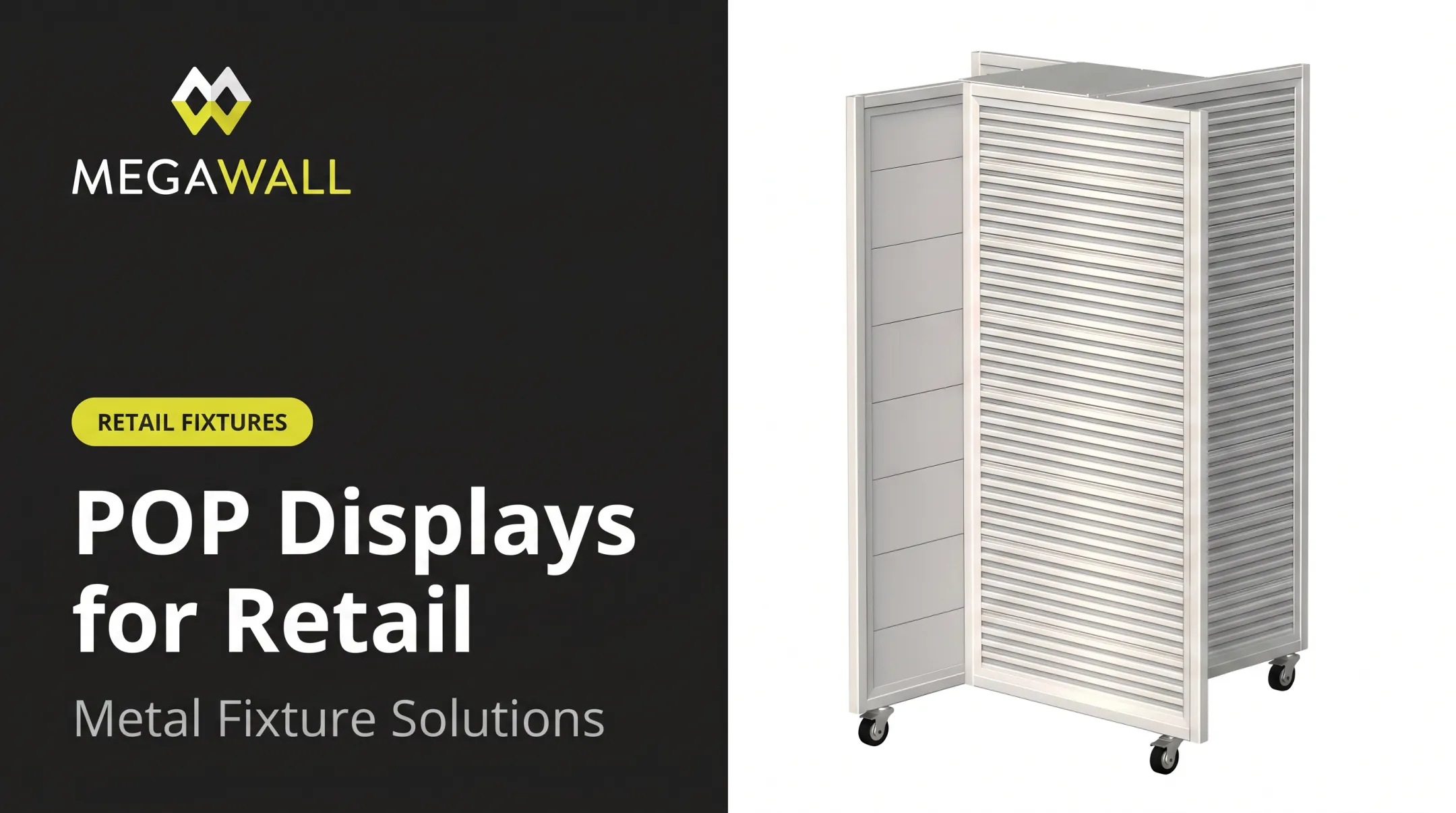
Fixture type matters here, too. Megawall's L-Frame is built to create a focal point and guide traffic toward impulse buys, while the Pinwheel offers four vertical display faces for tight footprints. Both make solid planning easier to execute—they don't replace it.

How to Use Impulse Displays (Step-by-Step)
Skipping zone-mapping or overloading a fixture with SKUs is the single most common reason impulse displays underperform.
Setup and Preparation
Map the store's natural traffic flow before choosing a location — not after. Walk the floor at different times of day and note where shoppers slow down or bunch up.
Avoid the most common setup error: cramming too many SKUs onto one fixture. More options don't guarantee more sales.
Assortment tests have shown compact sets (as few as six choices) beating much larger ones, even though choice-overload effects vary by category. Start with a compact, legible assortment and test from there.

Launch Timing and Signage
Impulse displays typically go live around seasonal calendars, promotional cycles, or new product launches. Signage and pricing need to launch simultaneously with the product — a stocked display with no price sign creates hesitation.
Signs of a correct setup:
- Visible from at least two approach angles
- Doesn't obstruct cart or foot flow
- Product-to-fixture ratio looks intentional, not thrown together
Operating Impulse Displays Correctly
Keep the product-to-display ratio full but not overcrowded. A packed-to-the-brim bin looks like clutter; a half-empty one looks abandoned.
Two operating rules keep conversion intact:
- Keep displays next to related categories so the buying trigger stays clear
- Restock before the fixture looks picked over — empty facings read as low demand, even when the SKU is selling
Monitoring During Use
Watch three signals:
- Dwell time near the fixture
- Restock frequency
- Sell-through rate
If a display needs frequent repositioning or shows low pickup despite full stock, that's a placement problem — not a product problem.
Refreshing or Rotating Displays
Rotate seasonal or underperforming SKUs on a fixed schedule, not whenever someone remembers. A static, stale display loses the "discovery" effect that drives impulse buys in the first place — shoppers stop seeing it at all after a few visits.
Where Impulse Displays Are Commonly Used in Practice
Four zones do most of the work:
| Zone | Typical fixture | Why it works |
|---|---|---|
| Decompression zone (first 5-15 feet) | Sparse platform or single feature | Shoppers are still orienting; don't overwhelm them |
| Power aisle / primary path | End caps, gondolas | High-traffic beacon points shoppers naturally pass |
| Seasonal areas | Bulk stacks, dump bins | Novelty drives discovery purchases |
| Checkout lanes | Counter units, small bins | Last-minute decision point for small, familiar items |

One large U.S. grocery transaction study found the front end cap drove higher purchase incidence than front-of-store or standard-shelf placements. That gap is why end caps stay a go-to fixture in power aisles.
Grocery, hardware, and general merchandise retailers apply these zones differently based on basket size and dwell time. A hardware store shopper dwells longer near project displays; a grocery shopper decides faster at checkout. Match fixture type and assortment depth to that behavior.
Best Practices for Using Impulse Displays Effectively
A few operational habits keep impulse displays converting instead of just occupying floor space:
- Keep assortment simple: A compact SKU range (roughly 3-5 items) avoids decision fatigue on most fixtures
- Use bold, honest signage at eye level: Put your priority item near natural sightlines, not buried on a bottom shelf
- Choose fixtures built for repeated resets: Fixtures that warp or loosen after one season cost more in lost sales than they saved. Steel slatwall rated for 50+ pounds per linear foot, with hidden fasteners and interlocking sections, holds up where MDF delaminates or sags
- Don't chase flashy design over discipline: Consistent restocking and traffic-based placement drive repeatable results far more than a clever fixture shape

Conclusion
Effective impulse displays rest on disciplined zone selection, simple product assortments, and consistent maintenance—done week after week, season after season. Treat them as an ongoing merchandising system, not a one-time setup.
That means fixtures built for the full cycle: repeated resets, heavier SKUs, and high-traffic wear. Megawall's steel and aluminum display systems are made for that load, so impulse zones stay working long after the first install.
Frequently Asked Questions
What is an impulse display?
An impulse display is a merchandising fixture designed to prompt unplanned purchases through high visibility, strategic placement, and clear pricing cues. It works by catching attention at a moment shoppers aren't actively searching for that product.
What are the five types of displays?
Common types include platform, multi-level, stepped, round, and dump-bin displays. Platforms suit focal vignettes; dump bins suit bulk, easy-access items.
What are the four types of impulse buying?
Retail research names four types: pure (spontaneous break from routine), reminder (revives a forgotten need), suggestion (creates a new perceived need), and planned (category expected, item chosen in-store).
Can you give me an example of an impulse buy?
Grabbing a pack of gum or a phone charger while waiting in the checkout line is a classic example. Neither was on the shopping list, but visibility and low cost prompted the decision.
What are the five P's of visual merchandising?
Product, Place, Price, Promotion, and People. Together they cover what's sold, where it sits, how it's priced, how it's promoted, and who delivers the experience.
Is there a difference between convenience shopping and impulse buying?
Yes. Convenience shopping means low-effort, planned buys of everyday items. Impulse buying is a sudden, unplanned urge. The same product, like checkout candy, can be either depending on the shopper.