
Here's why it matters so much: 76% of shopping decisions happen inside the store, not before, according to POPAI's Shopper Engagement Study of US grocery shoppers. Nearly one in six brand purchases happened simply because a display featuring that brand was present.
This guide covers the fundamentals every retailer needs: core principles, visual techniques, fixture strategy, signage, and the mistakes that quietly drain revenue.
Key Takeaways
- In-store decisions drive the majority of grocery purchases, making display execution a revenue lever, not decoration
- The 5 P's and 5 R's give retailers a repeatable framework for any category
- Fixture durability and modularity determine how fast (and cheaply) you can reset for seasons and promotions
- Out-of-stocks push roughly two-thirds of shoppers to a competitor
- Signage clarity and consistent execution across locations close the gap between plan and reality
What Is In-Store Merchandising?
In-store merchandising is the strategic presentation of products designed to maximize sales, improve the shopping experience, and reinforce brand identity. It's the layout, the lighting, the fixture choice, the sign that catches your eye near the entrance.
It's easy to confuse this with retail sales, but they're distinct functions. According to the U.S. Department of Labor's O*NET occupational database, merchandise displayers plan and arrange the physical presentation — the products, signage, and layout. Retail salespersons, by contrast, handle the actual transaction: answering questions, recommending items, closing the sale.
Merchandising creates the conditions for a sale. Sales staff convert them.
Core components include:
- Product assortment: what you stock, in what depth, and where it sits in the mix
- Store layout and traffic flow: how shoppers move and what they encounter first
- Displays and fixtures: the physical systems that hold and present product
- Signage: cues that orient shoppers and explain value or offers
- Pricing and promotion execution: how deals show up on the floor, not just in the plan
The 5 P's and 5 R's of Merchandising
Two frameworks anchor almost every successful merchandising strategy, and they work whether you're running a hardware store, sporting goods shop, or general merchandise chain.
The 5 P's
- Product — What you're selling and how it's assorted
- Price — Positioning relative to competitors and perceived value
- Place — Where products sit within the store
- Promotion — How you highlight seasonal or featured items
- Presentation — The physical display quality and cleanliness
The 5 R's
This is more of an inventory-and-placement discipline:
- Right product for the customer base
- Right place within the store
- Right time relative to demand cycles
- Right quantity to avoid gaps or overstock
- Right price to move inventory profitably
Placement matters more than most retailers assume. Shelf-positioning studies have found middle-shelf placement consistently outsold high or low shelves. That finding is a strong argument for testing eye-level positioning against your own SKUs and traffic patterns rather than assuming a fixed rule.
Applying both together: Say a hardware retailer is planning a spring reset. The 5 P's frame the big decisions: which products to feature, what promotional pricing applies, and where the display sits. The 5 R's govern execution, making sure garden tools show up in the right quantity, at the right shelf position, before the first warm weekend hits.

Visual Merchandising Techniques That Drive Sales
Strong visual merchandising directs attention, shapes traffic, and makes the next purchase feel obvious. These techniques work best when you apply them together rather than as one-off display tweaks.
The Rule of Three
Limit each display to a handful of featured products instead of crowding in everything available. Fewer choices, presented cleanly, convert better than a wall of options competing for attention. Group items in threes—such as good/better/best or product plus two complementary add-ons—to give shoppers a clear decision path.
Endcaps and Featured Placement
Endcaps work. A NAHPA Merchandising for Profit case study reported by Hardware Retailing found one hardware retailer generated an additional $50,212 in first-quarter sales and a 7.83% average profit-margin gain after optimizing endcap strategy alongside broader inventory changes. Treat this as a case study to model, not a guaranteed universal lift.
Color, Height, and Lighting
Small visual adjustments change whether shoppers notice a display or walk past it:
- Use color blocking to create anchors shoppers can spot from a distance
- Vary height within a display to avoid a flat, monotonous look
- Keep bright, even lighting on featured merchandise to stop foot traffic
Traffic Flow
A landmark US supermarket audit found counter-clockwise "racetrack" movement in 57% of right-entry stores, 55% of center-entry stores, and 47% of left-entry stores. Design your layout to guide shoppers past premium merchandise first, but test it in your own store rather than assuming universal behavior.
Five Display Types
Match the display type to the job—cross-sell, set-building, hero focus, demonstration, or interruption:
| Type | Example |
|---|---|
| Complementary | Grill accessories displayed beside grills |
| Coordinated | Matching outdoor furniture set |
| Single-product creative | One flagship product as a hero display |
| Product-in-use | A mounted power tool shown mid-task |
| Surprise-prop | Unexpected staging that stops shoppers mid-aisle |

Choosing the Right Fixtures and Store Layout
Displays are only as strong as what holds them. A brilliant seasonal display on a warped MDF shelf won't survive the season, let alone deliver ROI.
Modular Systems for Fast Resets
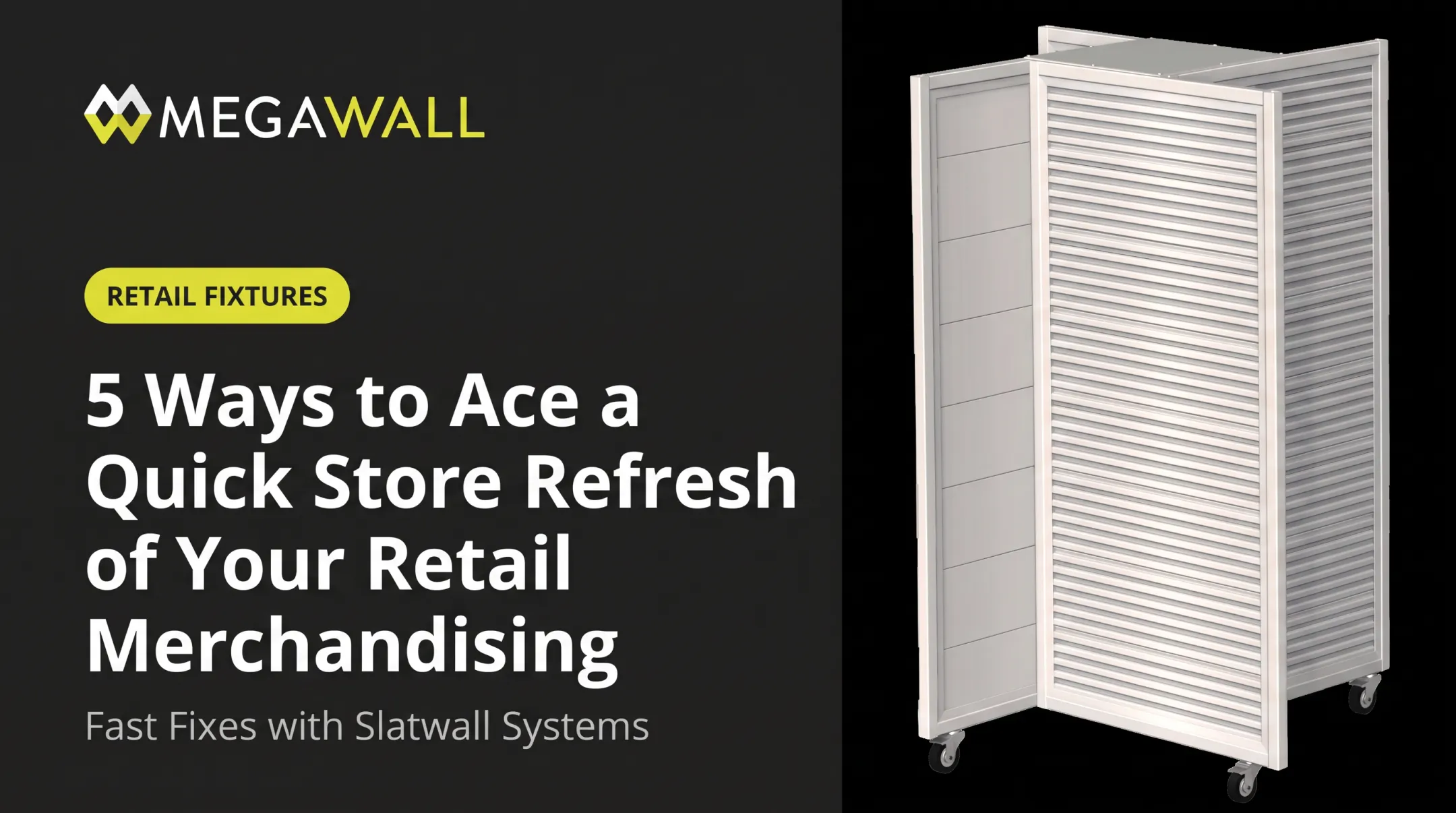
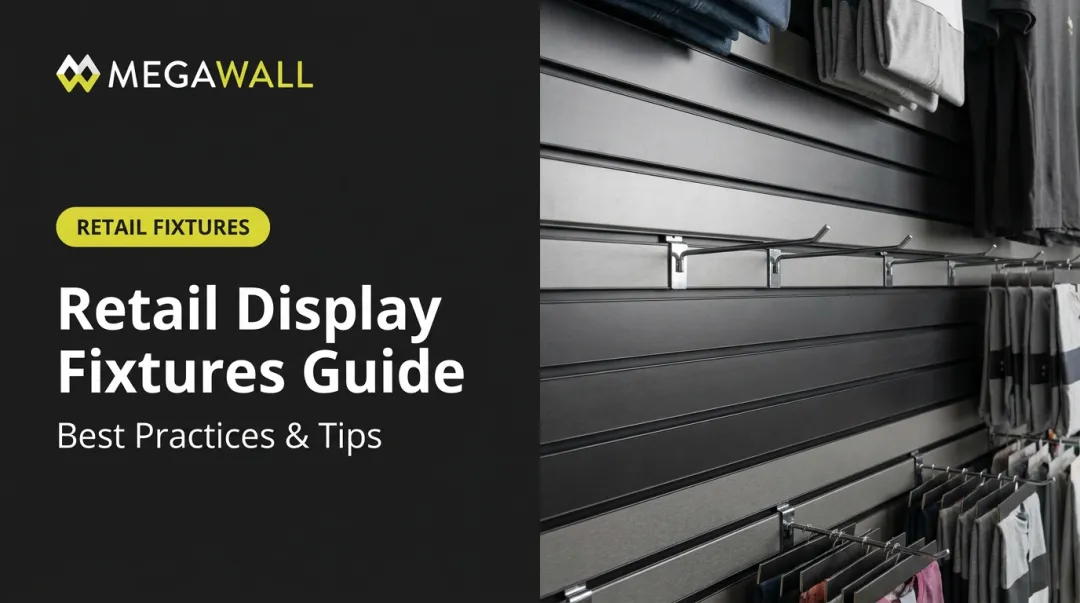
Modular, reconfigurable fixtures let retailers adapt layouts for seasonal changes and promotions without a costly remodel. Slatwall systems are the backbone here: panels that accept shelves, brackets, and peg hooks, and can be rearranged as assortments shift. Megawall's steel and aluminum slatwall lines hold over 50 lbs per linear foot, with hidden-fastener construction that conceals hardware behind the panel profile. That creates a seamless look across sections up to 8 feet long. The company's modular fixture designs (H-Frame, L-Frame, T-Frame, and Pinwheel) each solve a different layout problem:
- H-Frame: four wide sides for larger seasonal assortments
- L-Frame: a focal point that guides traffic and drives impulse buys
- T-Frame: a two-sided unit combining wall strength with movable flexibility
- Pinwheel: four vertical surfaces for tight-footprint spaces For retailers working with existing gondola layouts, retrofit panels like Megawall's NuPanel system drop into 36-inch or 48-inch gondolas in minutes. They convert standard gondolas into modular double-sided display surfaces without a full fixture replacement.

Fire Codes, Cleaning, and Long-Term ROI
Fixtures that meet fire codes and clean easily protect your investment over time. Megawall's aluminum slatwall, for instance, is made from over 50% recycled content, is LEED-certified, and meets fire codes while resisting the warping and delamination that plague conventional MDF displays. Durable, space-efficient fixtures also free up usable wall and floor space. Every square foot claimed by a bulky, single-purpose unit is a square foot not merchandising your next promotion.
Signage and the Customer Experience
Retail signage does three distinct jobs, and confusing them costs you conversions:
- Directional: Moves shoppers to a department or exit ("Tools → Aisle 4")
- Informative: Explains a product, price, or use case
- Invitational: Prompts shoppers to stop, compare, or try something
According to the Sign Research Foundation, shoppers scan signs quickly, and clutter, poor typography, and weak contrast all slow comprehension. Keep it simple:
- Large fonts, readable from normal shopper distance
- Short word counts: one job per sign
- Benefit-focused language, not feature lists

Well-placed signage reduces confusion and supports self-service discovery. That matters more as stores run with leaner floor staff.
Common In-Store Merchandising Mistakes to Avoid
Strong merchandising plans still fail when execution slips. These three mistakes cost retailers sales every day:
- Overcrowded shelves: Visual clutter overwhelms shoppers and slows decision-making. Chaotic shelves make finding products feel like work, and many shoppers won't bother.
- Frequent out-of-stocks: The costliest mistake on the list. AlixPartners' 2024 Holiday Survey found roughly two-thirds of consumers will abandon a store when a desired item is unavailable. For brick-and-mortar retailers, availability is non-negotiable.
- Inconsistent execution across locations: A display that looks sharp in one store and sloppy in another erodes brand trust. A documented merchandising calendar with reset dates, planogram standards, and photo compliance checks keeps every location aligned.
Frequently Asked Questions
What are the 5 R's of merchandising?
The 5 R's are Right product, Right place, Right time, Right quantity, and Right price. It's an execution framework that keeps inventory and placement decisions aligned with actual demand.
What are the 5 P's of merchandising?
Product, Price, Place, Promotion, and Presentation. These cover the strategic decisions behind what you sell, how you price it, and how you display it in-store.
Is merchandising the same as retail sales?
No. Merchandising sets the stage: layout, displays, and signage that create the conditions for a purchase. Retail sales is the actual transaction and customer interaction that converts interest into revenue.
What is in-store merchandising?
It's the strategic presentation of products to maximize sales, improve customer experience, and reinforce brand identity, covering assortment, layout, displays, signage, and pricing execution.
How often should a retailer refresh in-store displays and fixtures?
Most retailers refresh displays seasonally and around major promotional cycles. Modular, reconfigurable fixtures make frequent updates far less costly than fixed or built-in displays.
What makes a display fixture a good long-term investment?
Durability, weight capacity, ease of cleaning, and fire code compliance all matter. Fixtures rated for heavy loads and resistant to warping or delamination hold up through repeated resets without replacement.