
This guide walks through Open-to-Buy (OTB) planning, sourcing merchandise, and setting up your sales floor so that inventory actually sells once it arrives.
Key Takeaways
- Open-to-Buy formula ties purchasing to actual sales, stock levels, and cash flow
- ABC analysis (the 80/20 rule) focuses tighter control on the SKUs that drive most revenue
- Fixture systems matched to your merchandising plan speed sell-through once stock hits the floor
- Weekly tracking against your buy plan catches problems before they become overstock
Understanding Retail Inventory Planning Basics
Inventory, in a retail context, means finished merchandise sitting on your shelves waiting to be sold. That's different from a factory's raw materials or work-in-process—though the classic four categories are worth knowing:
- Raw materials – inputs used in manufacturing (rarely relevant to a retailer)
- Work in process (WIP) – partially finished goods (again, mostly a manufacturing concern)
- Finished goods – completed, sellable products (this is your store's core inventory)
- MRO – maintenance, repair, and operating supplies (think shopping bags, register tape, cleaning supplies)
Most independent retailers only need to manage finished goods and MRO. Manufacturing inventory logic rarely helps on a retail floor.
Why Turnover Rate Matters
Inventory turnover tells you how many times you sell through your stock in a given period:
Turnover = COGS ÷ Average Inventory
Say your cost of goods sold for the year is $300,000, and your average inventory value is $100,000. That's a turnover rate of 3x. Sporting goods retailers often run closer to 2.7x, while home improvement stores can hit 5-8x. Higher turnover generally means your cash isn't sitting idle on a shelf.
The 80/20 Rule (ABC Analysis)
Not every SKU deserves equal attention. ABC analysis ranks products by sales value:
- A items – your top performers, often a small slice of SKUs driving most revenue
- B items – steady, moderate sellers
- C items – slow movers that tie up cash and shelf space
The rough rule of thumb is that 20% of your products generate 80% of sales. Use it as a starting lens, then confirm against your own sales data.

How to Build an Open-to-Buy Plan for Merchandise Purchasing
Open-to-buy (OTB) is the budget that tells you exactly how much you can spend on new inventory without overbuying. The core formula:
Planned Sales + Planned Ending Inventory − Beginning Inventory = Purchases
A Step-by-Step Example
Let's say you run a hardware department:
- Beginning inventory (start of month): $40,000
- Planned sales for the month: $25,000
- Planned ending inventory (based on your turnover target): $35,000
- Calculation: $25,000 + $35,000 − $40,000 = $20,000 in open-to-buy
That $20,000 is your purchasing ceiling for the month, before subtracting anything already on order. If you've got $5,000 in unreceived POs, your real OTB drops to $15,000.

Setting Ending Inventory Targets
Work backward from your turnover goal. If you want 6x annual turnover and your average monthly COGS is $20,000, your average inventory should sit around $40,000. Adjust ending inventory targets department by department, not store-wide.
Adjusting Mid-Month or Mid-Season
If sales run hot, increase your OTB to avoid stockouts on your best sellers. If sales lag, cut planned receipts or push deliveries back. Review this weekly, not just at month's end. Waiting too long to react is how overstock happens.
Recording the Accounting Entry for Inventory Purchases
When merchandise arrives, record the purchase whether you pay cash or buy on credit:
Debit: Merchandise Inventory Credit: Accounts Payable (or Cash, if paid immediately)
A $20,000 inventory purchase increases your inventory asset account and creates a payable (or reduces cash). When those goods sell, move that cost from inventory into cost of goods sold.
Match purchase orders against receipts as goods arrive. That habit keeps the entry accurate and stops inventory and payable balances from drifting out of sync.
Steps to Plan and Source Merchandise for Your Store
Forecast From Real Data
Pull last year's sales by SKU and category. Layer in current trends, local events, and anything unusual (a competitor closing, a new development nearby). Don't buy purely on instinct.
Turn that view into a simple demand plan by category so every later PO ties back to real numbers.
Choose Your Sourcing Channels
- Manufacturers – best for private label or differentiated products
- Distributors – reliable for branded replenishment and breadth
- Wholesalers – good for smaller, mixed orders
- Trade shows – concentrated supplier discovery (ASD Market Week is one of the largest U.S. wholesale merchandise shows)
- B2B marketplaces – fast supplier comparison online
Negotiate Terms Before You Commit
Ask suppliers about:
- Minimum order quantities (MOQs) — these can range from dozens to thousands of units
- Lead times and fill-rate history
- Payment terms and damage/return policies
- Landed cost, not just unit price
A low MOQ preserves flexibility. A high MOQ can lower per-unit cost, but it locks up working capital if the product doesn't move.
Time Your Seasonal Buys
Work backward from your in-store date:
- Set the date you need merchandise on the floor
- Subtract supplier lead time and transit time
- Add time for inspection, allocation, and display setup
- Commit to POs by that resulting deadline

Hardware, sporting goods, and general merchandise run on different seasonal windows. Snow shovels and swimsuits don't share a calendar.
Apply the 5 R's Before You Buy
- Right merchandise – matches customer demand
- Right place – allocated to the store or department where it'll sell, on fixtures that can hold and present it clearly
- Right time – arrives when demand peaks
- Right quantity – enough to sell through without excess
- Right price – supports your margin goals
Maximizing Merchandising Space Once Inventory Arrives
Buying the right stock is only half the job. Poorly displayed merchandise still sells slowly—shoppers make roughly 76% of purchase decisions in the store, and displays strongly influence which brands they pick up.
Fixture quality has to match your buying plan, or fast-turning inventory sits unseen on weak or inflexible displays.
Fixtures That Support Fast Turnover
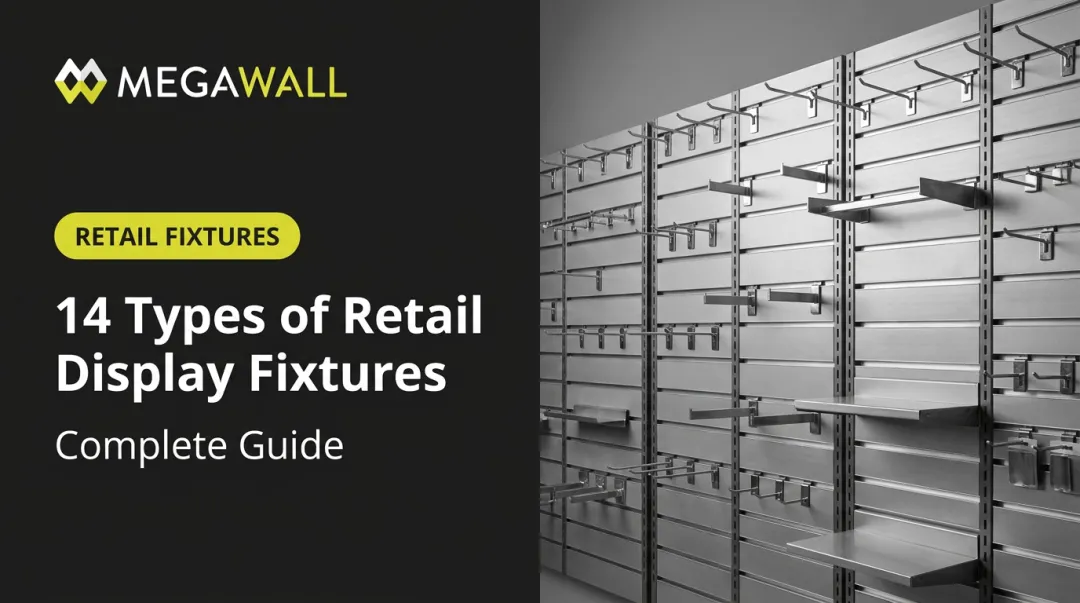
Slatwall systems, like the steel and aluminum panels Megawall manufactures, are built to hold more merchandise per linear foot than conventional MDF fixtures:
- 50+ lbs. per linear foot on steel and aluminum systems
- Hidden-fastener design for seamless sections up to 8 feet long
- Slat spacing from 1 to 3 inches on center, so you can reconfigure as assortments change
That load capacity matters when you're rotating heavier seasonal goods—patio hardware in spring, holiday merchandise in winter—without the panel sagging or the fasteners showing wear.

Modular Fixtures for Flexible Layouts
Beyond wall-mounted slatwall, modular fixtures give you floor flexibility:
- H-Frame: four-sided display, wheeled for repositioning
- L-Frame: creates a focal point that guides shopper traffic
- T-Frame: two-sided and stable; suited to opposing product categories
- Pinwheel: four vertical surfaces for tight floor space
These configurations help highlight seasonal inventory and promotional products without a full store remodel every quarter.
The ROI Case for Durable Fixtures
Steel and aluminum construction resists warping, breaking, and delamination in ways MDF cannot. Aluminum slatwall is easy to clean, contains over 50% recycled content, and is LEED-certified.
A fixture you are not replacing every two years stays clean and presentable, so merchandise looks sellable longer. That durability supports turnover, not just aesthetics.
Handling Slow-Moving and Unsold Inventory
Even a good buy plan produces some dead stock. Build an exit strategy into every seasonal purchase before you place the order.
Escalation ladder for slow sellers:
- Reposition to a better display location or add signage explaining the product
- Run a targeted promotion or first markdown
- Deepen the markdown or bundle with a faster-moving item
- Return to vendor (if your contract allows it)
- Liquidate through an outlet or secondary market
- Donate or repurpose as a last resort

Donations can carry tax benefits for qualifying inventory. Confirm deductibility and limits with your accountant before you count on them.
Set a review schedule. Flag anything that hasn't moved in 60-90 days for action. Waiting until year-end to deal with dead stock just ties up cash longer and crowds out space for merchandise that would actually sell.
Frequently Asked Questions
How do I buy inventory for a retail store?
Start by forecasting demand from historical sales data, then use the Open-to-Buy formula to set a purchasing ceiling. From there, choose reliable suppliers and negotiate terms that match your cash flow and sell-through expectations.
What's the best inventory management system for a retail store?
It depends on your store's size and complexity, but look for a system that integrates with your POS data and automates reorder alerts. Smaller stores can often manage well with spreadsheet-based OTB tracking paired with basic POS reporting.
What do stores do with inventory that doesn't sell?
Options include markdowns, promotions, returning to vendor where contracts allow, liquidation through outlets, or donation for a potential tax benefit. Most retailers use an escalating combination rather than one single tactic.
What are the four main types of inventory?
Raw materials, work-in-process, finished goods, and MRO (maintenance, repair, and operating supplies). Retailers mainly deal with finished goods and MRO supplies, since raw materials and WIP are manufacturing concepts.
What is the 80/20 rule in inventory?
It's the basis for ABC analysis, which ranks products by sales value or importance. Roughly 20% of your SKUs often drive about 80% of revenue, so those items deserve the tightest inventory control.
What are the 5 R's of merchandising?
Right merchandise, right place, right time, right quantity, and right price. Together they form a quick checklist for evaluating any purchase before you commit to it.