
That's not a hunch. A Dutch supermarket study tracked sales over 21 weeks and found the LED-lit half of the store sold 2% more products per customer than the section with older fluorescent fixtures. In a separate pilot at a Globus supermarket, colored LED lighting drove 6% higher sales and 15% more traffic in the promotional area.
Lighting isn't decoration. It's a merchandising tool. Below are seven tips to get it right, plus the fundamentals—lumens, CCT, CRI—that make those tips actually work.
Key Takeaways
- Layered lighting (ambient, accent, task, decorative) creates depth that single-source lighting can't match
- Color temperature and CRI directly shape how shoppers perceive your products and colors
- Quality display fixtures amplify lighting's impact; light alone doesn't sell merchandise
- Smart controls cut energy costs while adapting ambiance throughout the day
7 Tips to Enhance the Shopping Experience with Retail Lighting Design
Tip 1: Layer Ambient, Accent, and Task Lighting
A single light source flattens everything. No depth, no focal points, no reason for a shopper's eye to land anywhere specific. Layering fixes that.
- Ambient light sets the baseline: comfortable, even illumination for safe navigation
- Accent light creates contrast and draws attention to featured products
- Task light supports functional zones like checkout counters or fitting rooms
For circulation and general floor areas, aim for 20-40 footcandles. General merchandise displays need at least 50 footcandles, while special or hero displays can run 100-500 footcandles depending on the drama you want to create. Product walls typically land around 75-100 footcandles measured vertically.

Tip 2: Choose the Right Color Temperature (CCT) for Your Brand
CCT, measured in Kelvin, shapes mood more than most retailers realize. A boutique lit at 2700K feels intimate and warm. An electronics store at 4000K feels crisp and energetic.
Most retail settles between 3000-3500K. Dressing rooms and grocery stores often shift toward 4000-4500K for a fresher, more flattering effect on skin and produce alike.
Don't guess. Build a mock-up section with two or three CCT options and observe how merchandise, wall colors, and flooring respond before committing to a full rollout. What looks great on a spec sheet can wash out your product colors in person.
Tip 3: Prioritize High CRI for Accurate Product Color
CRI (Color Rendering Index) measures how accurately a light source reveals true colors compared to natural light, on a 0-100 scale. The Department of Energy calls 90 or higher excellent color fidelity for LEDs.
This matters for:
- Cosmetics — shoppers need to see true skin-tone matches
- Apparel — color mismatches lead to returns
- Jewelry — metals and stones lose their sparkle under poor rendering
For dressing rooms specifically, pay attention to R9 performance (a supplemental CRI metric), since it governs how warm, natural-looking skin tones appear under the light.

Tip 4: Use Accent Lighting to Draw Attention to Key Displays
Contrast is what makes a shopper's eye stop scanning and start focusing. A common starting point is roughly 3:1 accent-to-ambient contrast for standard merchandise displays, climbing to 5:1 or higher for hero products or window features.
Too little contrast, and nothing stands out. Too much, and everything else in the store looks dull by comparison. You also risk glare. Start conservative, then test.
Tip 5: Avoid Glare and Visual Chaos
Mismatched fixtures and harsh, unshielded bulbs create discomfort that pushes shoppers away from merchandise instead of toward it. A few fixes:
- Use small-aperture downlights and track lighting for controlled beams
- Angle display-case lighting toward products, never toward customer sightlines
- Position accent lights roughly one-third of the mounting height off the display face
- Choose matte finishes on fixtures and display surfaces to cut reflected glare
Walk the floor at customer eye height before finalizing any layout. What looks fine from a ladder often glares badly from five feet off the ground.
Tip 6: Light Fitting Rooms and High-Decision Areas Thoughtfully
Fitting rooms are where purchase decisions get made or abandoned. Research on dressing-room atmospherics confirms that lighting quality shapes how customers perceive both the garments and themselves.
Swap harsh overhead fluorescents for soft, diffused sources with strong R9 rendering. Warm, flattering light in a fitting room does more for conversion than almost any other single fixture change in the store.
Tip 7: Incorporate Smart Lighting Controls
Smart controls do double duty: they cut energy costs and adapt ambiance automatically. Berkeley Lab's meta-analysis of commercial buildings found average energy savings of:
- 24% from occupancy sensing
- 28% from daylight harvesting
- 31% from personal tuning
- 38% when combining multiple strategies

Beyond savings, connected systems can log foot traffic data, giving merchandising teams insight into which zones draw attention and which get skipped.
Lighting Fundamentals: Lumens, CCT, and CRI Explained
A lumen measures total light output from a source. A footcandle, the unit you'll actually design around, equals one lumen landing on a square foot of surface. That distinction matters: the lumen rating on a bulb's package tells you nothing about how bright your product wall actually looks until you factor in room size, reflectance, and mounting height.
CCT (correlated color temperature) describes the color appearance of light, measured in Kelvin. Lower numbers (2700-3000K) look warm and amber; higher numbers (4000K+) look cool and blue-white. It's printed right on most LED packaging.
CRI, as covered in Tip 3, measures color accuracy rather than brightness or warmth. A bulb can have a flattering CCT and still render colors poorly if its CRI is low. That's why both specs matter together.
Types of Commercial Lighting Fixtures for Retail
| Fixture Type | Best For |
|---|---|
| Recessed/track lighting | Ambient base layer plus repositionable accents |
| Pendant fixtures | Decorative brand statements over featured areas |
| Wall sconces | Vertical emphasis and texture |
| LED panels | Uniform ceiling-plane general lighting |
Two options show up more often in flagship and experiential retail:
- RGB dynamic lighting that shifts color for seasonal promotions
- IoT-connected fixtures that let managers adjust scenes remotely or gather occupancy data
These aren't right for every store, but they give operators more control over atmosphere and foot-traffic insights.
Pairing Great Lighting with Smart Merchandising Fixtures
Lighting design only solves half the problem. If your display fixtures are flimsy, mismatched, or visually cluttered, even perfectly calibrated accent lighting won't save the presentation. The light needs something worth highlighting.
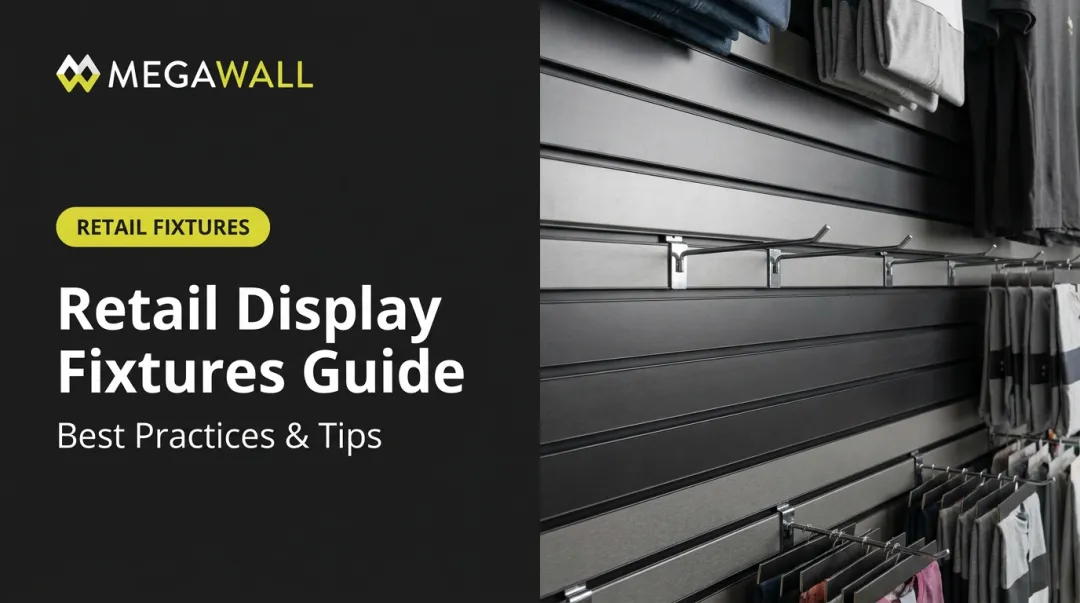
Display infrastructure matters as much as the fixtures overhead. Megawall's slatwall systems use hidden fasteners so the backdrop stays clean, and accent lighting draws the eye to merchandise instead of mounting brackets.
Specs that support a well-lit display:
- Hidden fasteners in 1-inch, 1½-inch, and 3-inch configurations
- Seamless sections up to 8 feet with no visible screws or hardware
- Over 50 pounds per linear foot, so shelves, brackets, and peg hooks layer without sag
Menda Wright, Co-Owner of Creative Studio Promotions, described Megawall's slatwall as "a focal point for all who enter." That professional surface helps lighting investments pay off instead of disappearing against a busy background.

For energy-conscious layouts, Megawall's aluminum slatwall is LEED-certified and made from over 50% recycled content. Retailers get a sustainability story that pairs cleanly with smart lighting controls elsewhere in the store.
Frequently Asked Questions
What are the recommended guidelines for retail store lighting design?
Follow a layered approach: ambient light at 20-40 footcandles, general displays at 50+ footcandles, and hero displays up to 500 footcandles. ANSI/IES RP-2-20 is the governing recommended practice for retail lighting in the US.
What type of lighting is best for retail stores?
LED lighting with a CRI of 90 or higher is preferred because it renders colors accurately while staying energy-efficient. The ideal CCT depends on your category: warmer for boutiques, cooler for electronics or grocery.
How many lumens are needed for a retail store?
Think in footcandles at the surface, not raw lumens: 20-40 fc for circulation, 50+ fc for general displays, and up to 500 fc for special displays. Use the IES lumen method for precise fixture planning.
What does CCT mean on lights?
CCT stands for correlated color temperature, measured in Kelvin. It describes whether a light appears warm and amber (lower Kelvin) or cool and blue-white (higher Kelvin).
What are some unique and quirky lighting ideas for stores?
Try RGB color-changing lights for seasonal displays, IoT-connected beacons that adjust scenes remotely, or novelty fixtures that reinforce brand identity.
What are the latest trends in commercial lighting?
Smart controls, IoT integration, and energy-efficient LED retrofits are the main trends. Retailers increasingly want systems that combine dimming, occupancy sensing, and daylight harvesting into one connected platform.