
But retail merchandising has changed. Products are heavier. Displays rotate more often. Customers expect a polished look, not a wall full of sagging hooks.
Choosing the wrong wall system doesn't just look bad — it affects safety, maintenance budgets, and how fast your team can reset a floor plan. This article breaks down why slatwall, particularly metal slatwall, has become the go-to pegboard alternative for retailers who've outgrown the basics.
TL;DR
- Pegboard is cheap and easy to source, but limited by weight capacity and moisture resistance
- Metal slatwall (steel or aluminum) offers stronger load capacity, cleaner looks, and longer service life
- French cleats, track rails, and magnetic panels exist but serve niche use cases
- The right pick depends on load, environment, and how often you change displays
- For retail walls, metal slatwall from Megawall typically wins on durability and display flexibility
Pegboard vs Slatwall: Quick Comparison
Cost
- Pegboard: Lowest entry cost — a 48 x 24 in. wood pegboard two-pack runs about $49 (light-duty use)
- Slatwall: Higher upfront cost — MDF panels run roughly $75 per 4 x 8 ft sheet; aluminum panels range about $70–$370 by size
- Metal slatwall: Costs more initially, but resists wear and replacement cycles that cheap pegboard invites
Composition
- Pegboard: hardboard, MDF, particleboard, or metal with pre-drilled holes
- Slatwall: MDF, PVC, or metal/aluminum panels with horizontal grooves
On the metal side, commercial systems vary by gauge and groove spacing. Megawall steel slatwall, for example, uses heavy-gauge formed-and-welded construction at 3 in. on center; its aluminum line offers 1, 1⅜, 1½, 2, and 3 in. spacing.
Durability
- Pegboard: Holes oval out with repeated hook changes; MDF and particleboard panels warp in humidity
- Slatwall (metal): Resists dents, scratches, and moisture and holds shape through heavy retail use
- Slatwall (MDF/PVC): Stronger groove engagement than pegboard, but still sensitive to moisture versus metal
Weight Capacity
| System | Published capacity |
|---|---|
| Wood pegboard (hardwood) | Up to 275 lb load / 425 lb total (product-specific) |
| Steel pegboard | Up to 200 lb, if properly installed and evenly distributed |
| Megawall steel slatwall | Over 50 lb per linear foot |
| Megawall aluminum slatwall | Over 50 lb per linear foot |
Pegboard ratings are usually panel- or point-load figures and vary by board, hardware, and install — there is no universal standard. Metal slatwall publishes a consistent per-linear-foot rating across the wall, not just at individual holes.

Maintenance & Cleanability
- Pegboard: Absorbs moisture and collects grime around holes
- Slatwall: Smooth grooves wipe clean; metal panels take repeated cleaning without warping, delaminating, or breaking down
What is Pegboard?
Pegboard is a perforated panel — hardboard, MDF, or metal — with evenly spaced holes that accept hooks, pegs, and brackets. It's been the default in garages, retail backrooms, and craft spaces for one simple reason: it's cheap and easy to customize.
There are three common variations, each with trade-offs:
- Hardboard pegboard – lowest cost, but least durable in humid environments
- Metal pegboard – stronger, but heavier and pricier than hardboard
- Plastic pegboard – lightweight but low load capacity
Use Cases of Pegboard
Pegboard shows up most in small retail displays, workshops, and craft rooms for hanging lightweight items. The problem is that published weight ratings vary wildly by product. Some hardboard listings don't even specify a load capacity at all. That inconsistency is exactly why heavier retail merchandising tends to outgrow pegboard fast.

What is Slatwall (and Why It's the Better Alternative)?
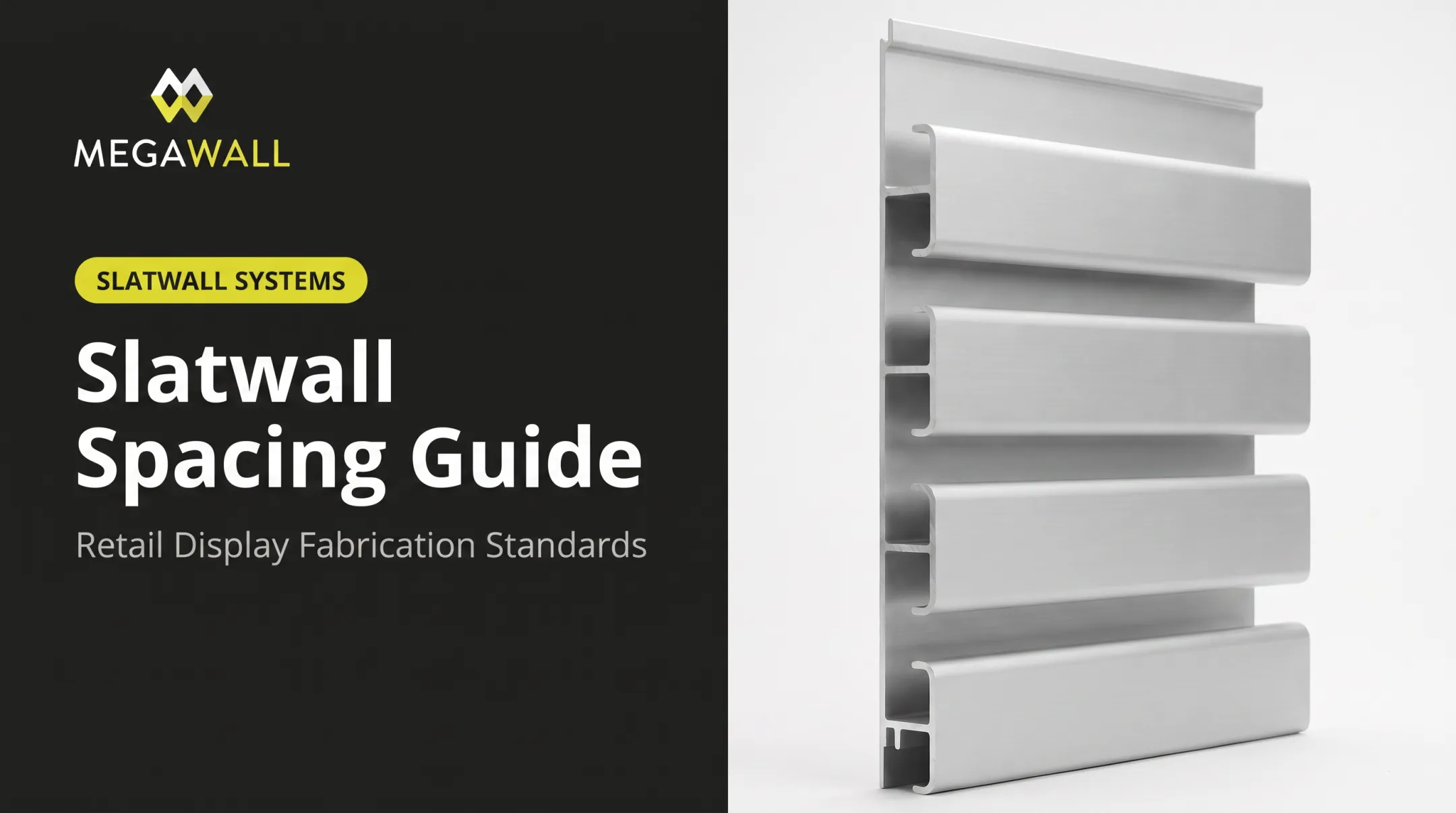
Slatwall is a grooved wall panel system. Instead of individual holes, accessories lock into horizontal channels, giving retailers a wider range of configurations without drilling new holes for every layout change.
That channel design shows up in day-to-day operations:
- Fewer broken hooks means less downtime for repairs
- Faster merchandising changes since accessories slide instead of unscrew
- A cleaner, more polished look for customer-facing walls
Metal Slatwall Solves the Durability Gap
MDF and PVC slatwall exist, but metal—steel or aluminum—is the real durability upgrade. Megawall's steel and aluminum systems share a few standout specs:
- 50+ lbs per linear foot load capacity on both steel and aluminum
- Hidden fasteners for a seamless look across sections up to 8 feet—no visible screws, no panel gaps
- Aluminum spacing from 1 to 3 inches on center, with a lighter build
- Over 50% recycled content and LEED certification on the aluminum line

Where Slatwall Works Best
Slatwall suits floor plans that change often: seasonal resets, promotional endcaps, and supply-driven merchandising shifts. Hardware stores, sporting goods retailers, and general merchandise chains rely on it because product mix and inventory volume rarely stay still.
A hardware buyer resetting an aisle from lawn care to snow removal, for example, can slide accessories into new positions in minutes instead of redrilling pegboard. The verifiable wins are flexibility, load capacity, and less fixture downtime—not soft sales-lift claims.
Pegboard vs Slatwall: What is Better?
The better choice depends on four factors:
- Load requirements: how heavy is what you're hanging?
- Layout changes: does the setup change weekly or stay static for years?
- Environment: humid, high-traffic, or a controlled back room?
- Long-term ROI: upfront cost versus repair and replacement over time
Choose pegboard for light, budget-conscious, low-traffic setups where the layout rarely changes.
Choose metal slatwall for retail environments, heavier merchandise, or high-traffic commercial spaces where durability and appearance matter.
Many businesses combine both systems: pegboard in the stockroom, slatwall on the sales floor. For merchandising-heavy retail walls, metal slatwall is the stronger long-term investment.
Real-World Example: Retail Wall Upgrade
Picture a mid-sized hardware store running standard hardboard pegboard across its tool and hardware aisles. Over a couple of years, the wear shows.
Hooks sag under drill sets and heavier hand tools. Panels near the entrance swell from humidity tracked in with foot traffic. Staff spend hours each month swapping out damaged sections.
The trigger to switch usually comes down to one of three things:
- Rising maintenance costs from repeated panel replacement
- Safety concerns after a hook pulls loose under load
- A need for a more polished storefront appearance to match a rebrand
Moving to a steel or aluminum slatwall system with concealed fasteners solves all three at once. The panels interlock for a seamless finish, the load rating is documented and consistent, and the smooth surface holds up under repeated cleaning.

The takeaway: Durable metal slatwall pays off fastest in high-traffic, high-turnover retail environments where downtime and replacement costs stack up quickly.
If your walls show the same wear pattern, choose a metal slatwall system built for that load. Megawall's steel and aluminum slatwall lines are manufactured in-house at a 45,000 sq ft facility in Michigan, with design and engineering support built into the process.
Conclusion
Pegboard still has its place — light loads, tight budgets, low-traffic corners of a stockroom. But businesses that need real weight capacity and a professional finish—plus walls that reconfigure without wearing out—get more from slatwall, especially metal.
The right choice comes down to matching the wall system to your actual merchandising demands. A quality slatwall system, like Megawall's steel and aluminum displays, cuts long-term maintenance costs and improves how your products are displayed.
Frequently Asked Questions
Which is better for a garage: pegboard or slatwall?
Slatwall generally offers more weight capacity and durability for garage storage, especially for heavier tools. Pegboard still works fine for lighter, budget-conscious setups where loads stay minimal.
What can I use instead of a pegboard?
Common alternatives include slatwall, French cleats, track rail systems, magnetic panels, and lockable wall cabinets. Slatwall is the closest match for retail-style display flexibility.
What is the best pegboard system for a garage?
Metal pegboard outperforms hardboard for garage durability. That said, slatwall systems typically outperform both when you're storing heavier or mixed items.
Are Skadis and pegboard the same thing?
Skadis is IKEA's proprietary pegboard-style system, using a similar hole-and-peg concept but with its own accessory ecosystem. It's a branded product line, not a generic industry standard.
What are some other names for a pegboard?
Common terms include perforated hardboard, Peg-Board (a formerly trademarked name), and pegboard panel. These are often used interchangeably in the industry.
Is metal slatwall worth the higher cost compared to pegboard?
For high-traffic or heavy-load retail settings, yes. Metal slatwall's documented load capacity and reduced repair needs typically deliver better long-term value than repeatedly replacing worn pegboard panels.