
Conversion rate is the metric that separates thriving stores from ones that just get lucky on busy weekends. The best part? You don't need more foot traffic to grow revenue. A modest bump in conversion rate — even a few percentage points — can outperform an expensive marketing push aimed at driving more people through the door.
This guide covers what conversion rate actually means, how to calculate it correctly, and 25 practical tactics you can start testing this week.
Key Takeaways
- Conversion rate = (Sales ÷ Total Visitors) × 100 — track it weekly to spot what's actually working
- Layout, merchandising, and fixture choices directly affect whether shoppers find and buy products
- Staff training, checkout speed, and psychological triggers like scarcity all lift conversion rates
- Traffic counters and POS analytics replace guesswork with real data
- Test one change at a time — don't roll out five tactics simultaneously without knowing what worked
What Is Retail Conversion Rate and How Do You Calculate It?
Retail conversion rate measures the percentage of store visitors who complete a purchase. It's the single clearest signal of how well your store (layout, staff, pricing, everything) is performing on any given day.
The formula:
Conversion Rate = (Number of Sales ÷ Number of Visitors) × 100
Example: If 400 people walk into your store on Saturday and 88 of them make a purchase, your conversion rate is (88 ÷ 400) × 100 = 22%.
There's no single verified national benchmark for U.S. brick-and-mortar conversion rates. Directional figures from industry sources suggest ranges by format:
- Specialty retail: about 15–30%
- Grocery: about 20–40%
- Big-box stores: about 10–20%
Figures are drawn from Shopify's retail conversion data. Treat them as reference points, not hard targets. Your own store's historical performance matters more than an industry average.
Common Mistakes When Measuring Conversion Rate
Bad data leads to bad decisions. Watch for these:
- Counting employees as visitors. Staff walking the floor inflates your traffic number and deflates your conversion rate.
- Including delivery drivers or vendors who enter through the front door
- Miscounting repeat entries, such as a shopper who steps out to the car and comes back in
- Inconsistent tracking periods. Comparing a holiday Saturday to a slow Tuesday skews your trend line.
Sensormatic's Employee Exclusion technology addresses the staff-contamination problem directly, filtering out employee movement so retailers get a cleaner traffic count. If you're using basic door counters without this filtering, build in a manual adjustment.

25 Top Ways to Increase Retail Store Conversion Rates
These tactics fall into five categories: layout and merchandising, staff and service, technology and checkout, promotions and psychology, and data and feedback. Start with whichever category matches your biggest weak spot.
Optimize Store Layout, Displays, and Merchandising
1. Design a decompression zone and a power wall. Shoppers need the first few steps inside your door to adjust. Don't put your best merchandise there. Build your "power wall" a bit further in, where attention has settled.
2. Group complementary products together. A customer buying hiking boots is a good candidate for wool socks and trail maps. Cross-merchandising increases basket size without extra foot traffic.
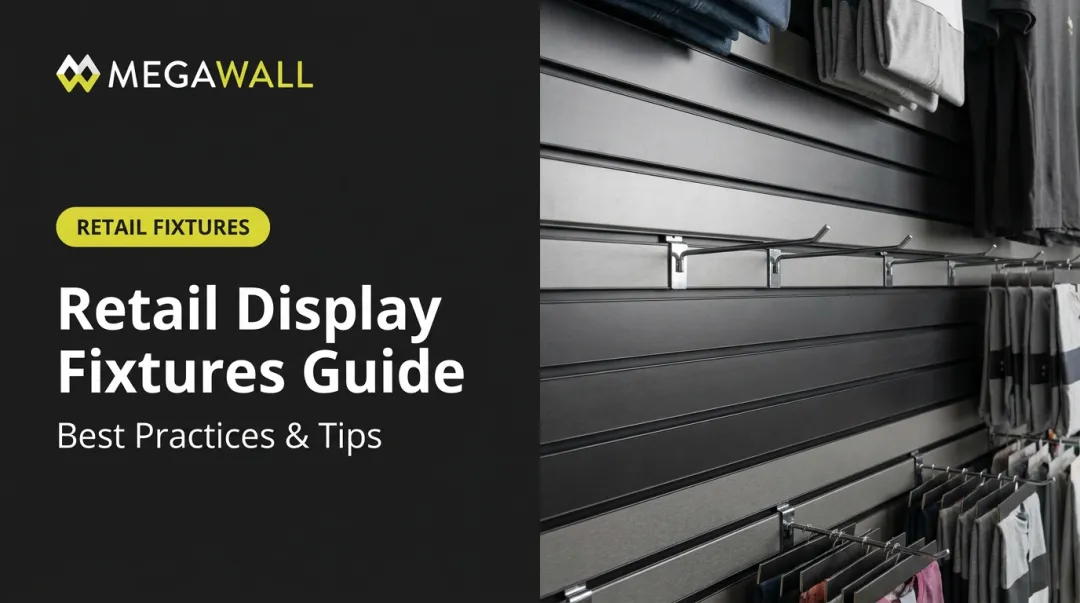
3. Invest in durable, well-organized fixtures. Cluttered, wobbly, or mismatched displays erode buyer confidence. Megawall's concealed-fastener slatwall systems create seamless sections up to 8 feet long with no visible hardware, so merchandise reads as organized rather than chaotic. Steel versions hold over 50 pounds per linear foot, far more than conventional MDF, and support heavier lines like tools or sporting goods.

4. Refresh your layout periodically. Repeat shoppers stop noticing a store that never changes. Modular fixtures like H-Frame and Pinwheel units, some mounted on wheels or casters, let you rearrange floor plans without a full remodel.
5. Use interactive displays and clear signage. Reducing search friction means fewer shoppers giving up and leaving. Signage should answer "where do I find X" before a customer has to ask.
Train and Empower Store Staff
6. Train staff to ask open-ended questions. "What are you shopping for today?" beats "Can I help you?" every time. The latter invites a reflexive "just looking."
7. Schedule based on traffic patterns, not just past sales. ShopperTrak found that the ten busiest shopping days accounted for nearly 44% of 2016 holiday foot traffic. Staffing to historical sales hours alone misses these traffic spikes.
8. Incentivize performance. Commission structures and recognition programs tie individual effort to store outcomes.
9. Invest in employee welfare. Motivated staff sell more. One European retail study linked each percentage-point increase in employee satisfaction to roughly a 1.3% increase in sales.
10. Equip staff with mobile devices. Checking inventory or closing a sale from anywhere on the floor removes the "let me go check" delay that kills momentum.
Speed Up Technology and Checkout
11. Modernize your POS. Multiple payment options and faster processing reduce abandonment at the final step.
12. Reduce visible queues. Nearly 40% of consumers abandon or switch stores when faced with long lines, and 80% avoid businesses with visible queues altogether, according to a 2025 Total Retail report. Relocating registers or enabling mobile checkout can hide that friction point entirely.

13. Offer free Wi-Fi and interactive kiosks. Shoppers researching products in-store are closer to a decision, not further from one.
14. Have a backup plan for out-of-stock items. Free shipping or buy-online-pickup options turn a near-loss into a completed sale.
15. Use cameras and traffic-counting tech. Accurate, real-time visitor data is the foundation for every other tactic on this list.
Use Promotions, Loyalty, and Psychological Triggers
16. Launch a loyalty program. Loyalty members tend to show stronger category penetration and purchase frequency, which correlates with higher sales and profitability over time.
17. Bundle products. Combining complementary items at a slight discount raises average transaction value without discounting your best sellers.
18. Use scarcity messaging carefully. A meta-analysis of 131 studies confirmed that scarcity cues generally increase perceived value and purchase intent, though the effect varies by product category and brand familiarity. "Only 3 left" works better on considered purchases than on staples.
19. Add social proof. In-store reviews, ratings, or testimonials near product displays reduce decision paralysis.
20. Offer free samples or refreshments. Reciprocity is a real psychological trigger — a small gesture nudges shoppers toward buying.
21. Host in-store events or demos. These build dwell time and brand connection simultaneously.
22. Gather feedback at checkout. A quick two-question survey surfaces friction points you'd otherwise miss.
23. Watch your dwell time metric. One widely cited study found that a 1% increase in dwell time corresponded to a 1.3% increase in sales. Simply making people wait longer isn't the goal; the increase needs to come from genuine engagement.

24. Partner with local organizations. Community ties drive foot traffic and trust that paid advertising can't replicate.
25. Iterate continuously. Conversion improvement is an ongoing analysis loop with no fixed end date.
How We Chose These Conversion-Boosting Strategies
These 25 tactics were selected based on real retailer use cases, measurable ROI potential, and applicability across store formats, from a 1,500-square-foot boutique to a big-box location.
Common mistakes to avoid:
- Applying one tactic store-wide without testing it in a single department first
- Ignoring dwell time and staffing data in favor of gut instinct
- Assuming a tactic that worked for a competitor will work identically for you
The strongest results come from combining physical improvements (layout, fixtures, and signage) with behavioral and data-driven tactics. Used together, they outperform either approach on its own.
Conclusion
Improving your conversion rate isn't a one-time fix. It's a cycle of testing, measuring, and refining, month after month.
Start small. Pick one or two tactics (maybe upgrading your display fixtures or streamlining checkout) and measure the impact before scaling further. Trying to overhaul everything at once makes it impossible to know what actually worked.
If your current fixtures are cluttered, mismatched, or held together with visible hardware that undermines a polished look, that's often a practical first place to start.
Megawall's slatwall systems and NuPanel gondola retrofits upgrade existing displays without a full-store remodel. That gives you a low-friction way to test whether better merchandising moves your numbers.
Frequently Asked Questions
How do I increase conversion rate in retail sales?
Start by optimizing store layout and displays, training staff to engage customers with open-ended questions, streamlining checkout, and using promotions or loyalty programs to turn browsers into buyers.
What are the 7 stages of conversion?
A common framework is awareness, interest, consideration, intent, evaluation, purchase, and loyalty. In-store, that maps to signage, browsing, staff engagement, product trials, comparison, checkout, and loyalty programs.
What is a good conversion rate for a retail store?
There's no universal benchmark. Specialty retail often lands around 15-30% and grocery around 20-40%, but results vary by category, format, and location. Track against your own historical data instead.
How do I calculate my store's conversion rate?
Use the formula: (Number of Sales ÷ Number of Visitors) × 100. You'll need a POS system for sales data and a visitor counter for accurate foot traffic.
Does store layout really affect conversion rates?
Yes. Layout controls product findability, dwell time, and impulse buys. Clear sight lines, strategic fixture placement, and uncluttered pathways all push conversion higher.
How can technology help increase retail conversions?
Traffic counters, POS analytics, and camera data show where and why shoppers drop off, so you can fix specific friction points instead of guessing.