
But with so many promotion formats available, retailers often struggle to pick the right one. Percentage discounts, BOGO deals, loyalty perks, free shipping thresholds — each works differently, and each fits different goals, margins, and store formats.
This guide breaks down the main types of retail sales promotions, explains how they work, and shows you how to choose and execute the right one for your store.
TL;DR
- Retail promotions are short-term tactics that boost sales, clear inventory, or win new customers
- Core types: %/$ off, BOGO and multi-buys, free shipping, loyalty offers, and gift-with-purchase or bundles
- Match the offer to your objective, product type, and margin tolerance
- Drive results with clear signage, strong in-store visibility, and consistent messaging
What Is a Retail Sales Promotion?
A retail sales promotion is a marketing tactic that offers shoppers a temporary incentive, typically a price reduction or added value, to encourage a purchase. The incentive is temporary by design, separate from everyday pricing strategy.
Retailers run promotions both online and in physical stores, often tied to:
- Seasonal shopping periods (back-to-school, holidays, end-of-season clearance)
- Inventory needs (overstock, discontinued lines, slow-moving SKUs)
- Customer acquisition goals (first-purchase discounts, referral offers)
Promotions work as a practical, results-driven sales tool. Retailers use them to move product and hit short-term numbers in a defined window.
Why Retail Sales Promotions Matter for Store Performance
Promotions directly influence conversion rates, average order value, and inventory turnover, particularly during peak selling seasons. Without a promotion strategy, retailers risk excess inventory, inconsistent cash flow, and missed opportunities to acquire new customers.
But an offer is only as strong as its presentation. According to a 2012 POPAI shopper engagement study reported by Supermarket News, 76% of shopping decisions were made in-store, and nearly one in six brand purchases happened when that brand's display was present. Displays do much of the heavy lifting when turning an offer into a sale.
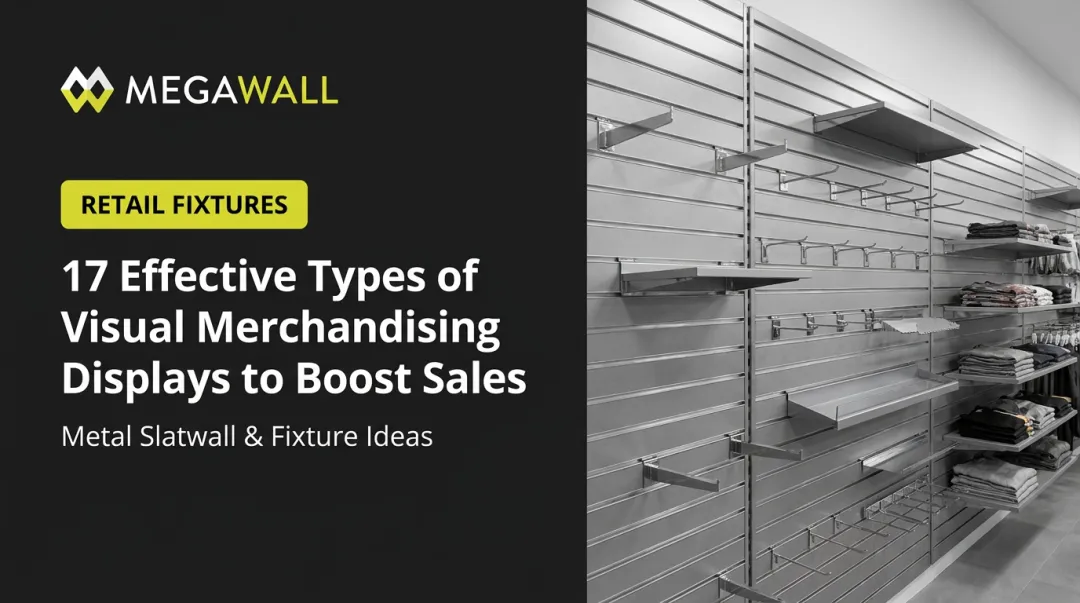
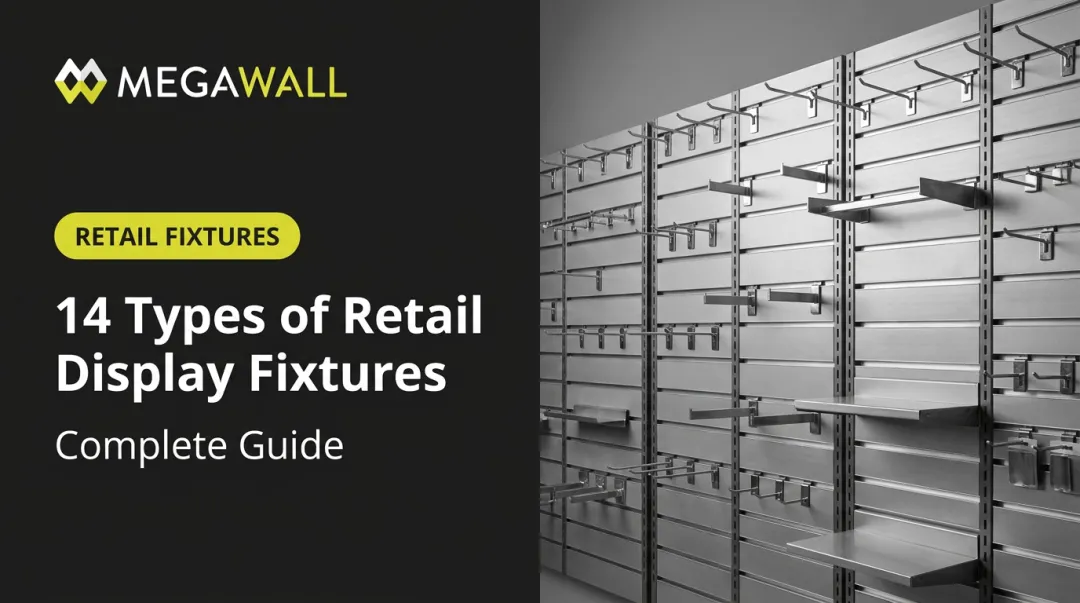
Organized, durable fixtures keep discounted or featured merchandise visible instead of buried on a back shelf. At Megawall, we build modular slatwall systems that accommodate shelves, brackets, and peg hooks. Retailers use them to group BOGO items, stack clearance products, or highlight seasonal promotions at different heights.

Key merchandising features that support promotional execution:
- Steel slatwall with 3-inch-on-center spacing; aluminum options from 1 to 3 inches
- Shelf brackets from 12 to 18 inches, holding over 50 lbs per linear foot
- Modular fixtures like the L-Frame, which creates a focal point and guides shopper traffic toward promoted items
Types of Retail Sales Promotions
Retail promotions aren't one-size-fits-all. The right type depends on your objective : traffic, clearance, loyalty, or average order value (AOV). Many retailers layer multiple promotion types together during peak selling seasons for maximum effect.
Percentage and Dollar-Amount Discounts
"% off" and "$ off" offers are the most familiar promotion type, applied storewide or at checkout.
- Difference: Simple price cuts with broad appeal, versus more targeted BOGO or loyalty mechanics
- Best suited for: Storewide sales events, seasonal clearance, price-sensitive shoppers
- Key strengths: Easy to communicate and instantly understood
- Limitations: Frequent or undisciplined discounting erodes margins fast. Test profitability before rolling out broadly
Research published in the Journal of Business Research found that for lower-priced products, percentage-off framing outperformed equivalent dollar-off framing in purchase intent.
BOGO and Multi-Buy Promotions
"Buy one, get one" and "buy X for the price of Y" deals focus on unit volume rather than straight price reduction.
- Difference: Moves inventory by quantity, not just by lowering the sticker price
- Best suited for: Excess inventory, commodity items, frequently purchased goods
- Key strengths: Clears stock quickly and increases units per transaction
- Limitations: Less effective for big-ticket or infrequent purchases. Straight "buy one get one free" usually beats "second half off," even when the math is nearly identical
Academic research comparing BOGO to equivalent percentage deals found shoppers paid more attention to, and preferred, BOGO framing over an equal-value percentage discount.

Free Shipping and Try-Before-You-Buy Offers
Conditional free shipping and trial-period purchase models reduce friction rather than cutting the sticker price.
- Difference: Removes a barrier to purchase instead of discounting the product itself
- Best suited for: Ecommerce retailers and higher-consideration purchases
- Key strengths: Builds buyer confidence and reduces cart abandonment
- Limitations: Shipping costs can erode margin if your minimum-order threshold isn't calibrated correctly
Loyalty, Conditional, and Insider Promotions
Point-based rewards, tiered perks, and spend-and-earn offers reward repeat behavior instead of offering one-time price cuts.
- Difference: Plays a long game, building retention rather than a single transaction
- Best suited for: Retailers focused on customer lifetime value
- Key strengths: Paid loyalty members spend far more at that retailer. Numerator's 2026 retail loyalty analysis found Kroger Boost members drove a 153% higher share of spending than non-members
- Limitations: Slower to show ROI than a flash discount; it's a retention play, not a quick-clearance tool
Gift-With-Purchase and Bundling Promotions
Free-gift-with-purchase offers and complementary product bundling add perceived value without discounting the core product's price.
- Difference: Protects price integrity while still sweetening the deal
- Best suited for: Retailers with healthy margins who want to boost AOV without training shoppers to expect markdowns
- Key strengths: Adds value shoppers notice without touching your price architecture
- Limitations: Requires thoughtful product pairing. A gift or bundle that feels random or mismatched can come across as forced rather than valuable
How to Choose the Right Type of Promotion for Your Store
The right promotion depends on your business goals, not what a competitor down the street is running. Consider these factors before committing:
- Primary objective: Foot traffic, inventory clearance, higher AOV, or retention—pick one main goal first.
- Product type and price point: Commodity goods suit BOGO; big-ticket items often respond better to percentage discounts or bundling.
- Margin tolerance: Know how much discount depth your profit structure can sustain before the promo hurts you.
- Sales channel: In-store promos hinge on display and signage; online promos depend on merchandising and checkout messaging.
- Promotion frequency: Deep discounts too often train shoppers to wait and erode full-price sales.

Common Mistakes to Avoid When Running Promotions
Even a strong offer can underperform if execution is sloppy. Watch for these pitfalls:
- No clear objective or end date: Promotions without a measurable goal or hard stop tend to drag on and erode margins indefinitely.
- Discounting too deep or too often: Deep, frequent discounts train loyal customers to skip full price and wait for the next sale.
- Weak in-store execution: Poor signage, cluttered fixtures, or hard-to-find promotional products can undercut even a strong offer.
Different promotion types serve different retail goals, so there is no single best choice. What turns a good promotion profitable is pairing the right offer with strong in-store presentation—organized slatwall displays, clear signage, and fixtures that guide shoppers to featured products.
Frequently Asked Questions
How can I increase sales in my retail store?
Combine a targeted promotion (like a percentage discount or BOGO) with strong visual merchandising and a smooth customer experience. Well-organized displays and clear signage often matter as much as the discount itself.
What are some effective sales promotion ideas for retail stores?
BOGO deals, percentage-off storewide sales, loyalty rewards, and gift-with-purchase bundles all work well for different goals. The best choice depends on whether you're clearing inventory, driving traffic, or building repeat customers.
Which sales promotion is most effective?
It depends on your product type, audience, and objective. There's no universal winner. Percentage discounts tend to perform well because shoppers understand them instantly.
What are the four types of sales promotion?
Most fall into four categories: price-based (discounts), value-based (BOGO, bundles), loyalty-based (points and tiers), and trial-based (free shipping, try-before-you-buy). Many retailers mix categories for stronger results.
What are the latest trends in retail?
Personalization, omnichannel promotions that connect online and in-store, and experiential merchandising are rising fast. Retailers are also expanding click-and-collect and in-store pickup as growth channels.
Do retail promotions need to be expensive to work?
No. Targeting the right audience and executing cleanly, especially through solid in-store display and signage, matters more than how deep the discount is. A modest, well-merchandised offer often outperforms a steep discount buried on a cluttered shelf.